Moving Object Detection Laboratory, ICAR-CNR
A Neural Self-Organizing Approach to the Detection of Moving Patterns for Real-Time Video Surveillance
Automated video surveillance using video analysis and understanding technology has become an important research topic in the area of computer vision. Our research activity is devoted to the analysis, design, and implementation of machine learning methods for the detection, tracking, and recognition of objects in motion sequences, with the principal aim of developing robust and accurate methods that are suitable for real-time applications. Within video understanding technology for surveillance use, moving object detection is known to be a significant and difficult research problem. Indeed, aside from the intrinsic usefulness of being able to segment video streams into moving and background components, moving object detection provides a focus of attention for recognition, classification, and activity analysis, making these later steps more efficient, since only moving pixels need be considered. In [1] the Self-Organizing Background Subtraction (SOBS) algorithm has been proposed, which implements an approach to moving object detection based on the neural background model automatically generated by a self-organizing method without prior knowledge about the involved patterns. Such adaptive model can handle scenes containing moving backgrounds, gradual illumination variations and camouflage, has no bootstrapping limitations, and can include into the background model shadows cast by moving objects.
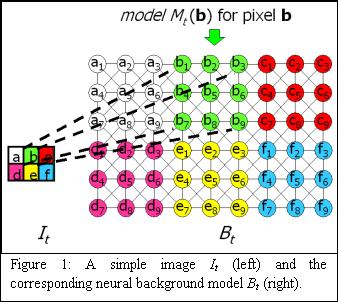 The basic idea consists in adopting visual attention mechanisms to help detecting objects that keep the user attention in accordance with a set of salient features, such as color, motion, and shape. The neural background model is built and updated by learning in a self-organizing manner background variations, and it is adopted for object detection through background subtraction. The adopted artificial neural network is organized as a 2-D flat grid of neurons, that allows to produce representations of training samples with lower dimensionality, at the same time preserving topological neighborhood relations of the input patterns. The network behaves as a competitive neural network that implements a winner-take-all function, with an associated mechanism that modifies the local synaptic plasticity of neurons, allowing learning to be spatially restricted to the local neighborhood of the most active neurons. Therefore, the neural background model well adapts to scene changes and can capture the most persisting features of the image sequence.
The SOBS algorithm achieves robust detection for different types of indoor and outdoor videos taken with stationary cameras, and favorably compares with most of the state-of-the-art algorithms for moving object detection (e.g., see www.changedetection.net).
The basic idea consists in adopting visual attention mechanisms to help detecting objects that keep the user attention in accordance with a set of salient features, such as color, motion, and shape. The neural background model is built and updated by learning in a self-organizing manner background variations, and it is adopted for object detection through background subtraction. The adopted artificial neural network is organized as a 2-D flat grid of neurons, that allows to produce representations of training samples with lower dimensionality, at the same time preserving topological neighborhood relations of the input patterns. The network behaves as a competitive neural network that implements a winner-take-all function, with an associated mechanism that modifies the local synaptic plasticity of neurons, allowing learning to be spatially restricted to the local neighborhood of the most active neurons. Therefore, the neural background model well adapts to scene changes and can capture the most persisting features of the image sequence.
The SOBS algorithm achieves robust detection for different types of indoor and outdoor videos taken with stationary cameras, and favorably compares with most of the state-of-the-art algorithms for moving object detection (e.g., see www.changedetection.net).
References
[1] L. Maddalena, A. Petrosino, A Self-Organizing Approach to Background Subtraction for Visual Surveillance Applications, IEEE Transactions on Image Processing, DOI 10.1109/TIP.2008.924285, Vol. 17, no. 7, pp. 1168-1177, July 2008. [Impact Factor: 3.315]